
Introduction
Traveling with a dog is exciting, but unfamiliar surroundings create risks that do not exist at home. A hotel door can open unexpectedly, a dog can slip out of a campsite, or an off-leash adventure can turn into a stressful search. That is why GPS dog trackers have become valuable travel equipment for many pet owners.
However, not every tracker marketed for dogs works the same way. Cellular GPS trackers, Bluetooth tags, and satellite or radio-based systems use completely different technologies. A Bluetooth tag may work well in a busy city but become much less useful on a remote hiking trail. A cellular tracker can provide live location updates, but only when compatible mobile coverage is available. Dedicated satellite or radio systems can be better for remote areas, although they usually cost more and require specialized equipment.
Understanding these differences before a trip can help you choose a tracker that matches your destination, your dog’s behavior, and the type of travel you plan to do.
How GPS Dog Trackers Actually Work
A common misconception is that every GPS tracker communicates directly with GPS satellites. GPS primarily determines the device’s position. It does not automatically send that position to your phone.
A typical cellular tracker uses satellite signals to calculate the dog’s location and then uses a cellular connection to transmit that information to an app. This distinction is important because a tracker can know where your dog is but still be unable to send that information to you if it cannot reach a mobile network.
Bluetooth trackers work differently. Products such as Apple AirTag use Bluetooth and a surrounding network of compatible devices to help determine the tag’s last detected location. They are not conventional GPS trackers and should not be treated as providing continuous live tracking.

Satellite and radio-based tracking systems take another approach. Some specialized systems communicate directly between a collar and a handheld receiver, making them particularly useful in areas where cellular service is unavailable.
Cellular GPS Dog Trackers for Everyday Travel
For most travelers, cellular GPS dog trackers provide the best balance between convenience and useful real-time location information.
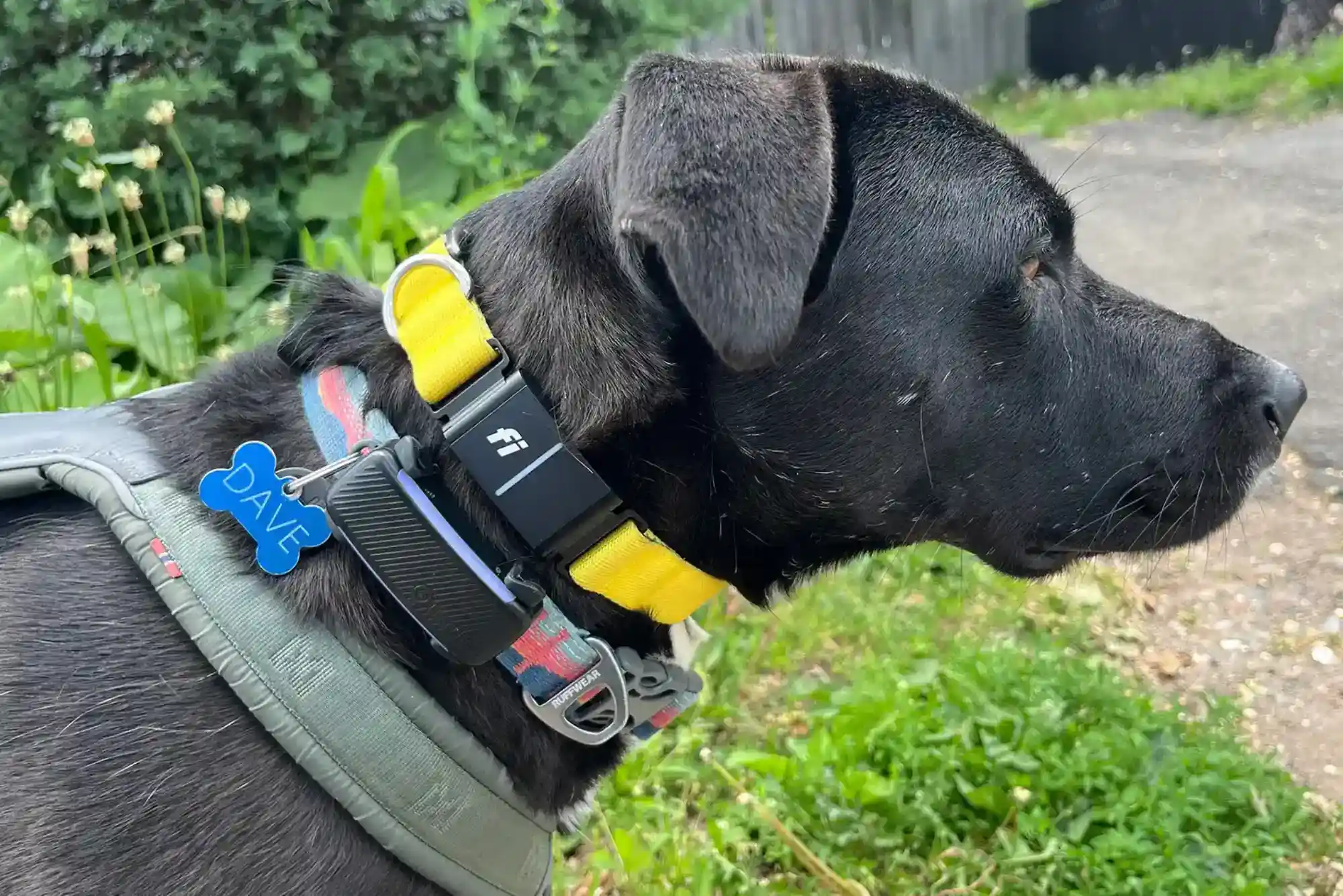
These devices generally contain a GPS receiver, cellular connectivity, a battery, and software that communicates with a smartphone app. When your dog is wearing the tracker, you can typically see its location on a map, review location history, and receive alerts if the dog leaves a designated safe area.
This makes cellular trackers particularly useful during road trips, hotel stays, vacations, campground visits, and walks in unfamiliar neighborhoods.
Why cellular tracking is useful
The biggest advantage is that you can monitor your dog from your phone rather than carrying a separate tracking receiver. Many modern systems also offer geofencing, escape alerts, location history, and activity monitoring.
Tractive, Fi, and similar products use cellular networks to transmit GPS-derived locations. Current comparisons generally place cellular tracker subscriptions in the roughly $5–$15 monthly range, depending on the provider and plan.
For international travel, network compatibility becomes especially important. Some trackers are designed primarily for one country, while others support multiple countries through cellular roaming arrangements. Always verify coverage for the specific countries you are visiting rather than assuming that a tracker will work internationally.
The main limitation
Cellular GPS is not truly unlimited. Your dog’s tracker needs compatible cellular coverage to transmit fresh information to your phone.
This becomes important when hiking through remote mountains, traveling through areas with weak reception, or camping far from populated locations. The tracker may still calculate its position, but you might not receive a current update until connectivity returns.
Battery life is another consideration. Frequent live tracking consumes considerably more power than occasional location checks, so charging becomes part of your travel routine.
Bluetooth Trackers: Helpful Backup, Not Full GPS
Bluetooth trackers are attractive because they are inexpensive, compact, and generally do not require a monthly tracking subscription.
An Apple AirTag is a well-known example. It does not contain a conventional GPS receiver or cellular modem. Instead, it broadcasts a Bluetooth signal that can be detected by compatible nearby devices, which can then help report its location through a crowd-sourced network.
This can work surprisingly well in crowded urban environments where many compatible smartphones are nearby.
When Bluetooth makes sense
A Bluetooth tag can be useful as a secondary layer of protection. For example, you might attach one to your dog’s collar alongside a cellular tracker.
It can also be practical for short trips around populated areas where the primary concern is that your dog gets separated from you in a park, hotel, airport, or busy neighborhood.
Why Bluetooth has important limitations
The biggest problem is dependence on nearby devices.
If your dog runs into a sparsely populated forest, rural road, or remote campsite, there may be few compatible phones nearby to detect the Bluetooth signal. In that situation, the tracker may only show an older location rather than the dog’s current position.
For that reason, Bluetooth trackers should generally be considered a backup identification and finding tool rather than a replacement for live GPS tracking.
Satellite and Radio Tracking for Remote Adventures
If your travels regularly take you beyond cellular coverage, a dedicated off-grid tracking system deserves consideration.
Specialized Garmin tracking systems, for example, can use direct radio communication between the dog’s collar and a handheld receiver. This approach does not depend on a cellular tower. Garmin’s radio-based systems are designed for demanding outdoor use, including hunting and remote terrain, where conventional phone-based tracking can fail.
The advantage of going off-grid
The obvious benefit is independence from cellular networks.
Imagine hiking with your dog through a large wilderness area. If your dog disappears around a ridge, a conventional cellular tracker may stop providing updates when reception disappears. A suitable radio tracking system can continue communicating directly with your handheld receiver.
This makes these systems especially attractive to hunters, backcountry hikers, search-and-rescue users, and owners who routinely travel in areas with unreliable mobile coverage.
The trade-off
Off-grid tracking equipment is usually more expensive and less convenient than a simple phone-based tracker.
You may need a dedicated handheld device, a compatible collar, and additional equipment. Instead of simply opening an app, you also need to learn how the tracking system works.
For occasional family vacations, that extra complexity may not be worthwhile. For serious wilderness travel, however, the additional capability can justify the investment.
How to Choose GPS Dog Trackers for Travel
The best GPS dog trackers are not necessarily the ones with the longest advertised battery life or the most features. The right choice depends on how and where you travel.
Consider your destination first
If your trip involves cities, suburbs, highways, and established campgrounds, a cellular tracker is usually the most practical option.
If you are traveling internationally, check the tracker’s supported countries and cellular network arrangements before purchasing it.
For remote wilderness travel, look closely at radio or satellite-based alternatives. Never assume that a cellular tracker will work simply because the manufacturer describes it as having GPS.
Consider your dog’s behavior
A calm dog that stays close during walks may need only basic location protection.
An escape-prone dog is a different situation. For a dog that frequently bolts through doors or gates, geofence and escape alerts can be more valuable than activity statistics.
Some cellular trackers can alert you when a dog leaves a predefined safe zone. That early warning can give you a chance to react before your dog travels too far.
Consider battery life carefully
Advertised battery life can be misleading because real-world performance depends heavily on how often the tracker communicates.
Live tracking, weak cellular coverage, frequent movement, and repeated location requests can consume more power.
Before leaving home, fully charge the tracker and confirm how it behaves in active tracking mode. If you are going on a multi-day trip, bring the correct charging cable and, where appropriate, a portable power bank.
Consider the size and weight
A tracker that works beautifully on a large Labrador may be uncomfortable on a small dog.
Look at the physical dimensions, attachment system, waterproofing, and collar compatibility. The device should be secure enough that your dog cannot easily shake or scratch it off.
A tracker is useless if it gets lost while your dog is still wearing the collar.
Why You Should Not Rely on One Technology Alone
Travel creates unpredictable conditions, so redundancy can be valuable.
A practical setup for many travelers is a cellular tracker as the primary device and a Bluetooth tag as a secondary backup. The cellular tracker can provide live location when coverage exists, while the Bluetooth tag provides another way to identify or locate the collar in populated areas.
For serious wilderness travel, a dedicated radio or satellite solution may make more sense than relying on cellular service.
Regardless of the technology, a tracker should complement—not replace—your dog’s identification. Your dog should still have a secure ID tag with current contact information and a registered microchip.
Technology can fail. Batteries can die, collars can break, and networks can disappear. A layered approach gives you more options if something goes wrong.
GPS Dog Trackers for Road Trips
Road trips are one of the easiest situations in which to benefit from a cellular tracker.
Your dog may encounter unfamiliar hotels, rest areas, parks, rental properties, and busy streets. Even a normally obedient dog can become disoriented in a new environment.
Before leaving, create a safe-zone around your current location and check that alerts are enabled. When you arrive at a new destination, update the safe area rather than continuing to use the one from home.
It is also worth checking the tracker before every major stop. Make sure it has enough battery, is firmly attached, and is successfully communicating with the app.
GPS Dog Trackers for Hiking and Camping
Hiking introduces a more complicated question: how much cellular coverage will you have?
A cellular tracker can be excellent when hiking in areas with reliable network coverage. It provides the convenience of phone-based location monitoring and can be particularly useful if your dog runs ahead on a trail.
However, coverage can change quickly in forests, valleys, mountains, and remote areas.
If your adventures regularly take place beyond cellular coverage, consider a purpose-built radio or satellite tracking system instead. The additional cost and equipment can be worthwhile when reliable communication matters more than convenience.
Common Mistakes to Avoid When Buying a Dog Tracker
One of the biggest mistakes is assuming that every product labeled a “GPS tracker” offers live GPS tracking.
Bluetooth tags are a perfect example. They can be useful, but their operating model is fundamentally different from a cellular GPS tracker.
Another mistake is ignoring subscription costs. A low-priced tracker may become considerably more expensive over several years once cellular service fees are included.
Coverage is equally important. A tracker that works beautifully at home may not be suitable for an international trip or remote camping destination.
Finally, do not wait until your vacation to test the device. Install the app, charge the tracker, attach it securely, create alerts, and test the location function before traveling.
Are GPS Dog Trackers Worth It for Travel?
For many dog owners, yes.
Travel introduces enough uncertainty that knowing where your dog is can provide valuable peace of mind. Cellular GPS dog trackers are particularly useful for everyday travel because they combine location tracking with smartphone convenience.
Bluetooth devices are affordable and useful as an additional layer, especially in populated areas. Dedicated radio or satellite solutions are more appropriate when your adventures take you far beyond cellular coverage.
The most important thing is matching the technology to the environment. A cheap Bluetooth tag may be perfectly reasonable for a city vacation, while a backcountry traveler may need a specialized off-grid system.
Choose the Tracker That Matches Your Adventure
The best GPS dog trackers for traveling are not identical because travelers do not have identical needs.
Cellular trackers are generally the strongest all-purpose option for road trips, hotels, cities, and areas with reliable mobile coverage. Bluetooth trackers are affordable backup tools that can be particularly useful around populated areas. Radio and satellite-based systems are better suited to serious outdoor adventures where cellular coverage cannot be trusted.
Before your next trip, consider your destination, your dog’s behavior, expected network coverage, battery requirements, and total ownership cost. Then choose the tracking technology that gives you the best balance of reliability and convenience.
A tracker cannot prevent every escape, but it can dramatically improve your ability to respond when something goes wrong.
FAQs
Do GPS dog trackers work without cell service?
Most cellular GPS dog trackers can determine their location using satellite signals, but they generally need cellular connectivity to transmit that location to your phone. Without mobile coverage, fresh location updates may not reach the app until the tracker reconnects.
For completely off-grid tracking, a compatible radio-based system or another communication technology designed for remote areas is more appropriate.
What is the best GPS tracker for a dog?
There is no single best tracker for every dog. Cellular options such as Tractive and Fi are strong choices for everyday tracking where supported cellular networks are available. Specialized Garmin systems can be better for remote or off-grid use.
The best option depends primarily on where you travel and whether you need live location, escape alerts, international coverage, or off-grid operation.
Can I use an AirTag to track my dog?
Yes, but an AirTag should not be confused with a dedicated GPS dog tracker. AirTag relies on Bluetooth and nearby devices participating in Apple’s finding network rather than continuously transmitting GPS coordinates through a cellular connection.
It can be a useful backup, particularly in populated areas, but it is less dependable for remote hiking or rural travel.
Is a GPS dog tracker worth it for traveling?
For many owners, a tracker is worthwhile because unfamiliar environments create additional opportunities for dogs to escape. A cellular tracker can provide location information and alerts that make it easier to respond quickly if a dog leaves a safe area.
The value is especially high for dogs that are nervous in unfamiliar places, prone to running, or frequently taken hiking and camping.
Do GPS dog trackers require a monthly fee?
Many cellular GPS trackers require a subscription because they use mobile networks to transmit location information. Bluetooth tags generally do not require a cellular tracking subscription, while specialized radio systems can operate without monthly cellular fees.
When comparing products, consider the total cost over several years rather than looking only at the initial device price.
How accurate are GPS dog trackers?
Accuracy varies according to the device, satellite visibility, surroundings, and network conditions. Open outdoor areas generally provide better positioning conditions than dense buildings, heavy tree cover, or deep valleys.
More importantly, remember that GPS accuracy and communication coverage are separate issues. A tracker can calculate a location but still be unable to send that location to your phone when cellular connectivity is unavailable.
Can a GPS dog tracker replace a microchip?
No. A GPS tracker is an electronic location tool, while a microchip provides permanent identification if a dog is found and taken to a veterinary clinic or shelter.
Responsible pet travel should include both permanent identification and a functioning tracking device, along with a secure ID tag containing current contact information.